Architecture
Webhook System Design & Architecture
A reliable, scalable architecture for event-driven workflows.
- Event-driven architecture planning
- Retry & backoff policies
- Idempotency strategy
- Webhook delivery modeling
- Monitoring & alerting design
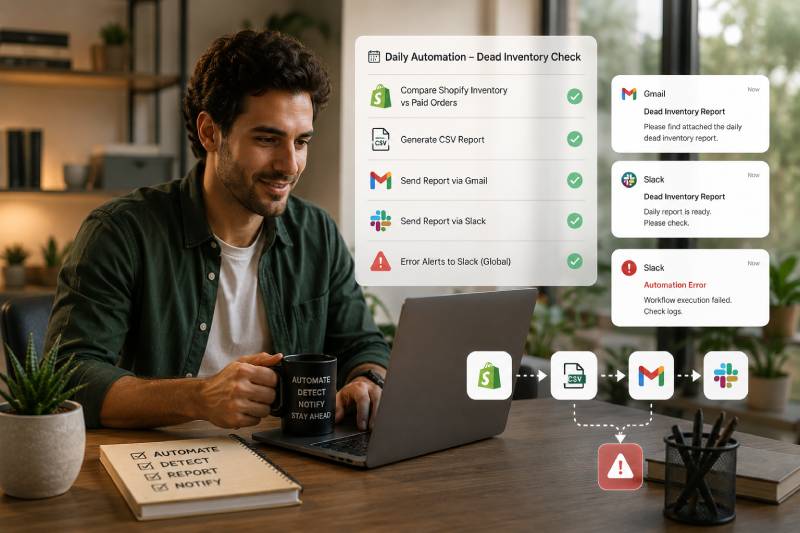
Most teams realize they need webhook engineering only after losing events, delivering duplicates, or building patches that became fragile over time.
We don’t plug random endpoints together. We design webhook systems with verification, retries, queues, monitoring, and operational visibility — built to handle real business volume.
The best webhook projects usually begin with one event your business cares about: a new order, a new lead, a payment, a status change, or a workflow handoff.
A new order, fulfillment status update, or refund triggers a webhook that updates internal tools, accounting systems, fulfillment partners, or customer notifications.
Order is placed on the store
Webhook fires with order payload
Webhook is signed and verified
Internal systems, finance, and 3PL get updated
Customer notification is triggered
Webhooks unlock real-time business workflows — but only if they are designed with verification, retries, queues, observability, and clear ownership.
Webhooks deliver data the moment it happens, instead of forcing systems to repeatedly ask.
Retries, queues, and dead-letter handling make sure events don’t disappear silently.
Signing, validation, and access control prevent spoofed or tampered events.
Logs, dashboards, and audit trails give real visibility into what happened.
As volume and partners grow, you need verification, queues, retries, observability, and predictable behavior.
| What matters | Basic endpoint | Polling | YourBrand Webhook Systems |
|---|---|---|---|
| Real-time updates | Yes | No | Yes, with reliability |
| Retry on failure | Manual or none | N/A | Automated retries + backoff |
| Security | Often missing | N/A | Signed, verified, rate-limited |
| Duplicate handling | None | N/A | Idempotency-first design |
| Audit and logs | Limited | N/A | Full delivery history |
| High-volume handling | Often breaks | Slow and heavy | Queues and scaling-ready |
| Failure recovery | Manual | Inconsistent | Dead-letter queues and replay |
You don’t need to know event-driven patterns. We define events, payloads, retries, and operational behavior around your actual business needs.
Review events, integrations, pain points, and reliability needs.
Define event types, payloads, signing rules, and retry strategy.
Implement receivers, publishers, queues, and observability.
Run failure simulations and security checks.
Document events, payloads, retries, and integration steps.
Deploy with monitoring and alerting.
Extend, harden, and scale as needed.
Replace these examples with real client outcomes once available.
An ecommerce brand was relying on hourly syncs. We built webhook delivery with retries and verification for real-time order routing.
A SaaS team needed customer-facing webhook subscriptions. We built signing, retries, subscriber management, and documentation.
A growing business was missing webhook events from Stripe. We added queues, retries, and audit logs to fully resolve the issue.
What teams usually ask before building webhook systems
Book a free webhook review. We’ll look at your event-driven workflows, integration partners, and reliability issues — then recommend the most practical webhook system to build first.
We design and build webhook systems that deliver events between your tools, products, partners, and customers in real time — with retries, signing, queues, and failure handling that keep your business workflows reliable.
Real-time event delivery between systems
Continuous webhook listening and processing
Every webhook covered with safe delivery
Typical timeline for a focused webhook system